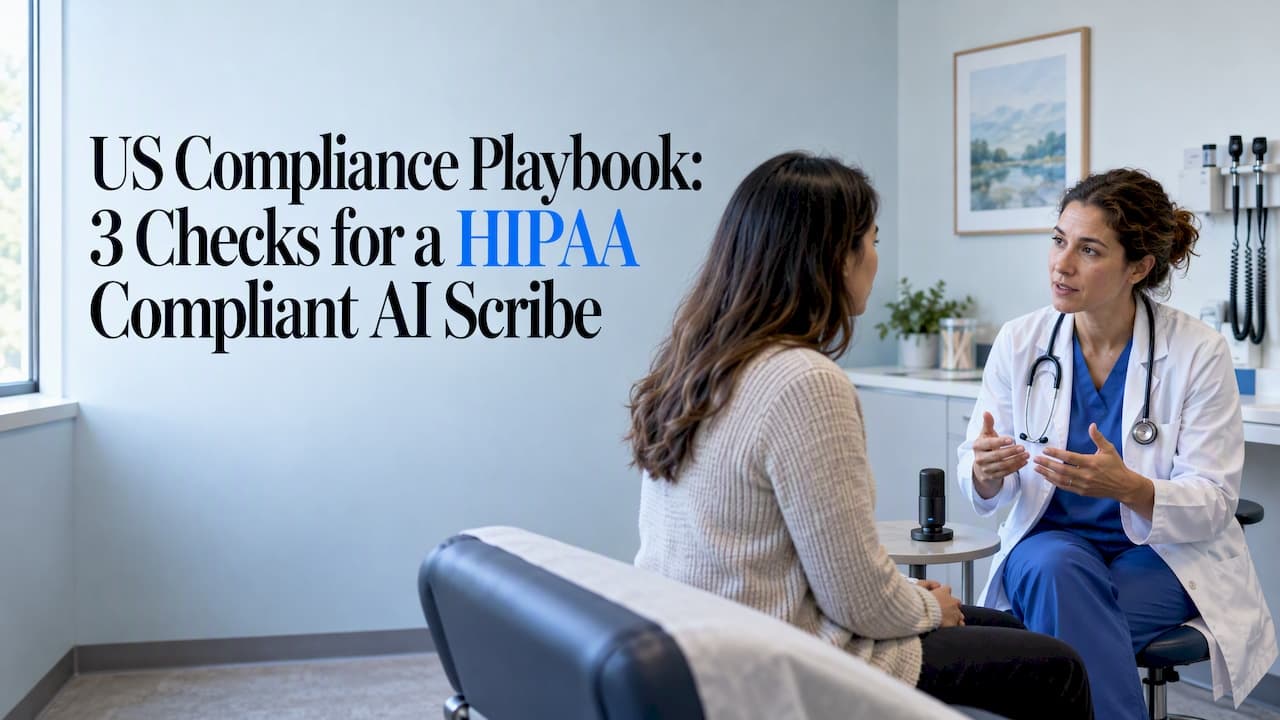
Yes, you can deploy an AI scribe compliantly, but you must treat the vendor as a business associate, complete a Security Risk Analysis, and implement documented consent and data flow controls before live use. The evidence you need sits in HHS OCR guidance, peer-reviewed validation studies, and the vendor's own documentation. Get these three pieces lined up before anyone records a patient conversation.
TL;DR:
- An AI scribe vendor becomes a business associate under HIPAA if it creates, receives, or transmits protected health information on behalf of a provider, incurring direct liability and enforcement actions.
- Conduct a comprehensive and documented Security Risk Analysis before live deployment, covering data creation, access, breach procedures, and technical safeguards such as encryption and audit logs.
- Obtain explicit patient consent for recording and secondary use, using enforceable workflows that allow revocation and retain audit records to ensure compliance and accountability.
- Ensure data in the AI scribe pipeline is ephemeral when possible, with strict encryption, logging, retention limits, and clinician review as mandatory steps before notes reach the electronic health record.
- Ongoing compliance requires staff training, vendor evidence updates, periodic access reviews, and a tested incident response plan, as responsibility remains with the covered entity even post-contract.
Table of Contents
- When does an AI scribe vendor become a business associate?
- Scoping the Security Risk Analysis before you go live
- How should patient consent work with an AI scribe?
- Mapping where ePHI travels through the scribe pipeline
- Keeping the program compliant after launch
- Does the AI scribe actually get the note right?
- How a Clinical Scribe fits the compliance checklist
- Setting realistic expectations for adoption
- Ready to pilot a compliant AI scribe
- FAQ
- Sources
When does an AI scribe vendor become a business associate?
An AI scribe vendor that creates, receives, maintains, or transmits protected health information on behalf of a covered entity is a business associate under HIPAA, full stop. That classification triggers direct liability under HITECH amendments and OCR enforcement, meaning the vendor itself can be investigated and fined, not just the clinic or hospital that hired it. Encryption or a lack of vendor access to decrypted data does not change this: HHS guidance on cloud computing confirms that a covered entity using a processor without an executed BAA is violating HIPAA regardless of technical safeguards in place.
Before you sign anything, confirm the agreement covers these points:
- Permitted uses and disclosures limited strictly to the services contracted, with no default right to use transcripts for model training.
- A clear prohibition on secondary uses, including research or product improvement, without separate explicit authorization.
- Breach notification timelines and responsibilities, specifying how fast the vendor must alert you after discovering an incident.
- Audit and cooperation rights, letting you request logs, attestations, or third-party assessments on a defined schedule.
- Subcontractor flow-down language, so any sub-processor the vendor uses is bound by equivalent terms.
- Data return or destruction obligations at contract termination, with a documented method and timeframe.
Hand this checklist to legal and procurement as a baseline, not a formality. A vendor that resists any of these terms is signaling how it will behave after something goes wrong.
Scoping the Security Risk Analysis before you go live
HIPAA requires an accurate and thorough Security Risk Analysis covering every ePHI asset touched by the scribe, and this analysis has to be documented, not assumed. OCR and NIST materials treat risk analysis as a continuing requirement, so a one-time checklist at procurement is not enough; addressable specifications need either the recommended control or a documented, equivalent alternative.
Scope your SRA around these questions in order:
- Where does audio, transcript, or draft note data get created, and does it ever leave your network boundary?
- Who, including vendor staff and subcontractors, can technically access ePHI at each processing stage?
- What happens to data if the vendor's infrastructure is breached, and how fast would you find out?
- Which technical safeguards are already in place, and which are missing or only partially implemented?
The technical controls worth verifying directly, not taking on faith, include encryption at rest and in transit with documented key management, role-based access controls scoped to minimum necessary, multi-factor authentication on every administrative interface, immutable audit logging, and a written retention and secure deletion policy for raw audio and intermediate drafts.
Pro Tip: Run the SRA before the pilot starts, not after, and schedule a lightweight re-analysis any time the vendor reports a material change to its processing pipeline.
How should patient consent work with an AI scribe?
Recording and transcribing a clinical encounter sits in a gray zone that most state consent laws were not written for, which means you need a documented consent workflow even where the law is ambiguous. The sharper compliance issue is secondary use: using transcripts or notes to train models, benchmark accuracy, or build new features requires separate, explicit opt-in that patients can decline without affecting their care.

Consent-as-code turns this from a policy document into an enforceable system. FHIR Consent resources let you bind a specific consent grant to a specific encounter, so the system itself knows what a given transcript may be used for. Data segmentation standards like DS4P attach security labels to sensitive content, which prevents a downstream process from using data outside its authorized scope even if someone forgets to check manually.
Operationally, this comes down to a few concrete pieces:
- A short, consistent script front desk or clinical staff use to explain recording and secondary use before the encounter starts.
- A consent capture interface that logs the patient's choice against that specific visit, not a blanket annual form.
- A revocation path that propagates instantly, so withdrawing consent actually stops future secondary use rather than just flagging a database row.
- Retained consent records available for audit, matching the same retention window as the clinical documentation itself.
Pro Tip: Treat consent revocation as a technical event, not a paperwork update. If revoking consent takes a support ticket instead of a toggle, your system is not actually enforcing it.
Mapping where ePHI travels through the scribe pipeline
A typical AI scribe pipeline moves through five hops: audio capture, automatic speech recognition, large language model processing, draft note generation, and clinician review before anything reaches the EHR. Each hop has a different risk profile, and the compliance question is not "is this encrypted" but "does ePHI persist here longer than it needs to."
Audio capture and ASR output should ideally be ephemeral: processed, transcribed, and discarded rather than stored indefinitely. LLM processing is where most vendors persist some intermediate data for quality or debugging purposes, which is exactly where your SRA and BAA language need to be explicit about retention limits.
For each hop, require:
- Encryption in transit and at rest, with no exceptions for "internal" processing steps.
- Access logs that record which system or person touched the data, not just that an event occurred.
- A documented retention ceiling for raw audio, intermediate transcripts, and draft notes, with automatic deletion enforced rather than manual.
- Clinician review as a mandatory gate before any note writes back to the EHR, with provenance tags showing the note originated from AI assistance.
- Version history on the final note, supporting both clinical accuracy reviews and patient access requests.
Write-back to the EHR should never happen automatically. A clinician's sign-off is both a clinical safety control and a compliance checkpoint, since it creates the human accountability record that OCR expects to see in an audit.
Keeping the program compliant after launch
Deployment is the easy part. Sustaining compliance means ongoing workforce training, monitoring, and a tested incident response plan, because a signed BAA and a clean SRA at launch do not protect you against drift six months later.
- Train every staff member who touches the scribe on minimum necessary access and your specific consent workflow, not generic HIPAA refreshers.
- Review role-based access quarterly, removing accounts for staff who changed roles or left.
- Request vendor evidence on a recurring schedule: updated audit logs, penetration test summaries, and attestations of continued safeguards.
- Maintain a written incident response playbook covering detection, containment, and OCR breach notification timelines, with vendor coordination responsibilities spelled out in the BAA.
- Re-test the system any time the vendor announces a model or pipeline change, since that is effectively a new system from a risk standpoint.
The HHS privacy guidance is explicit that covered entities remain responsible for compliance even when a vendor has signed a BAA. Outsourcing the task never outsources the accountability.
Does the AI scribe actually get the note right?

Accuracy is not a footnote to compliance, it is the center of it, because an error in a clinical note is a patient safety issue before it is anything else. A JMIR validation study found errors in 70% of draft notes produced by ambient AI scribes, with omissions the most frequent type at a mean of 2.9 errors per draft. A separate PDQI-9 based evaluation found ambient notes scored well on thoroughness but showed a higher hallucination rate than physician-written notes, 31% versus 20%.
A workable validation protocol for a pilot should include:
- A representative sample across the specialties you actually use the scribe in, not a single department's results.
- Blinded clinician review comparing AI drafts against physician-written notes using a validated instrument like PDQI-9.
- Explicit hallucination checks, including adversarial prompts designed to surface fabricated content.
- A defined acceptance threshold for error rate and hallucination rate before the vendor moves from pilot to full deployment.
- A re-validation trigger tied to any vendor-reported model change.
How a Clinical Scribe fits the compliance checklist
When evaluating Clinical Scribe against the checklist above, we built Medgram's EHR-side extension specifically so clinicians review and finalize every note before it reaches the chart, keeping the human sign-off gate intact. Our HIPAA compliance page and Notice of Privacy Practices outline the privacy commitments we document for verified professionals.
For procurement, request an executed BAA template, a summary of Security Risk Analysis scope, integration architecture documentation showing where audio and transcript data travels, access to audit logs, and any pilot results that can be shared. Ask specifically how the Clinical Scribe supports consent-as-code workflows and segmentation, since that is where most vendor evaluations fall short on specifics rather than general assurances.
Setting realistic expectations for adoption
AI scribes save documentation time, but a 70% draft error rate in published validation work means residual risk never hits zero. Plan a staged rollout: small pilot, blinded accuracy review, then department-by-department expansion with a fixed monitoring cadence, not a single go-live date. A signed BAA and a vendor's internal testing do not transfer your responsibility as the covered entity. You still own the outcome, and your audit trail needs to show that.
— Dina
Ready to pilot a compliant AI scribe

A short pilot tells you more than any vendor pitch. Ask for a BAA, an SRA summary, and integration documentation up front, then run a 4 to 6 week test with a defined accuracy threshold before expanding further.
- Request a BAA template, SRA summary, and integration architecture documentation during your first call.
- Scope the pilot to one or two departments with a blinded note review at the midpoint and end.
- Set a measurable success criterion, such as an acceptable error rate, before the pilot begins, not after.
- Review our Clinical Scribe page and EHR clinical tools for the full feature set, or book time through our interactive demo to walk through documentation live.
FAQ
Is AI Scribe HIPAA compliant?
An AI scribe can be used in a HIPAA compliant way when the vendor signs a business associate agreement, the covered entity completes a Security Risk Analysis, and technical safeguards like encryption and access controls are verified rather than assumed. No AI scribe is compliant by default, compliance comes from the contract, the configuration, and the oversight around it.
Are any AI tools HIPAA compliant?
No AI tool is inherently HIPAA compliant on its own, since compliance depends on a signed BAA, a documented risk analysis, and verified technical safeguards rather than a product label. A tool that handles ePHI without an executed BAA puts the covered entity in violation regardless of how secure its infrastructure claims to be, per HHS cloud computing guidance.
Do you need patient consent to use AI Scribe?
Documented consent is strongly recommended for recording and transcribing clinical encounters, and separate explicit opt-in is required before any transcript or note is used for secondary purposes like model training. A consistent consent script at intake, paired with a revocation workflow that actually stops future secondary use, covers both the clinical and the audit requirement.
Which AI agents are HIPAA compliant?
There is no official government list of "HIPAA compliant" AI agents, since compliance is a function of the agreement and controls in place between a specific vendor and a specific covered entity, not a certification a product earns once. The practical approach is requesting a vendor's BAA, SRA summary, and audit documentation directly rather than relying on marketing claims of compliance.
What evidence should we request from an AI scribe vendor before a pilot?
Ask for an executed BAA, a summary of the vendor's Security Risk Analysis, documentation of the data flow architecture showing where ePHI is processed and stored, and access to audit logs. Independent or peer-reviewed validation data on note accuracy and hallucination rates, such as the error patterns found in a JMIR instrument validation study, gives you a benchmark to compare against the vendor's own claims.
Sources
- Hhs
- Accuracy and Safety of AI-Enabled Scribe Technology: Instrument Validation Study | JMIR
- Assessing the quality of AI-generated clinical notes: validated evaluation | Frontiers